
To get an idea of the size of the project, there are 25,000 to 30,000 cylinders per line per day, reaching a total of close to 1 million cylinders per line per month, says the company’s CIO, Flávio Baltensberger.
Flávio Baltensberger, CIO of Supergasbras, acknowledges the hype surrounding artificial intelligence—especially generative intelligence—and says the gas distributor is working to incorporate it where it truly delivers value. In a conversation with Convergência Digital, the CIO detailed the projects in which the company has seen AI incorporation make sense and shared details about when and how the company, part of the Dutch group SHV Energy, has been studying the technology.
The journey toward AI began more strongly in the last five years, when the digital transformation department was created, aligned with the company’s macro strategy, whose structural pillars include, among other topics, performance improvement and operations optimization. “We understand that digital, innovation, and security permeate all pillars. Digital transformation can encompass many aspects, and we decided that here it will be about transforming the customer and employee experience and that we will be data-driven,” said Flávio Baltensberger.
The goal is to transform the customer experience to a digital one, but to achieve this, it was necessary to take a step back and map the journeys of different consumers. This is because Supergasbras serves both bulk (when a tank is installed and periodically filled with gas) for large customers, such as agribusiness, industry, and commerce, as well as cylinders sold indirectly (through resellers) to end consumers—the latter is the flagship product, accounting, according to Baltensberger, for 70% of sales volume.
It also uses individual metering to determine how much, for example, a unit in a building consumed from the tank sold in bulk. “Today, we have telemetry in the tanks and AI solutions to identify changes in consumption in these tanks,” Baltensberger explained. After designing the journey, the company identified the touchpoints and how customers would like to be served.
During this process, Supergasbras identified challenges in its operations that could be overcome with technology. One of them was filling the cylinder. When the gas cylinder returns from the customer, it may still have some gas inside or even be dirty. This can be a problem because, by rule, the company is required to deliver the cylinder weighing 13 kg.
“We look at the cylinder’s tare weight to determine how much the can weighs, and we add 13 kg to that. However, each cylinder has a different weight, and we need to be sure of the cylinder’s tare weight. This number is written on the cylinder, and the margin of error is 100 g,” explained Baltensberger.
Under the previous process, people entered the cylinder’s weight, which is written along with other information on the can, into a system. Accuracy is crucial to ensure the product is neither overfilled nor underfilled. Four operators spent full time entering the cylinder’s tare weight, which took four seconds and could be error-prone—so another process involved double-checking. In other words, there was room for efficiency improvement.
So, in an evolution, the cylinders began passing through a tunnel with cameras that digitize the information, automating the process. “When we did this, the cylinder reading time went from four seconds to 0.45 seconds,” says the CIO. To make it work, a reading algorithm was developed to transform the image into data. “It reads the cylinder’s expiration date, because every ten years I have to requalify the cylinder. It reads the cylinder’s tare weight and sends it to the production line, which has a machine with a filling nozzle, indicating how much to add,” explains Baltensberger.
To give you an idea of the project’s scale, 25,000 to 30,000 cylinders are filled per line per day, reaching a total of close to 1 million cylinders per line per month. “Initially, there was resistance from those working, but we didn’t fire anyone; we reassigned them to more important roles,” he says. At the facility where the pilot was run, there were two shifts of four people, who were retrained from typists to qualification analysts—and other employees were assigned to other roles, the CIO explained.
Currently, nearly 7 million cylinders are filled using this system, which has a 98.9% accuracy rate. “We have 1% back for reanalysis, and before it was 10%,” he added, noting that the margin of error has dropped to zero. “This 1% is when the algorithm can’t read for various reasons, such as old markings, dirt, or rust,” he said.
The solution, which enables the automatic interpretation of gas cylinder images using AI and computer vision, was developed in conjunction with Fu2re. The pilot project, which uses images of gas cylinders to automatically identify their tare weight and expiration date before they enter the distribution process, began in late 2023 and went into production on selected lines in Rio de Janeiro in 2024. The goal is to expand the system to other units. The project’s success helped the CIO demonstrate the technology’s efficiency.
Other projects
On the operational side, Supergasbras is working with Fu2re on a solution for gate control. “The cylinder is our biggest asset, and cylinder management is significant. When the truck enters the base, someone checks it, counts how many cylinders are in the truck, and matches the number with the invoice. The same happens upon departure,” explained the CIO.
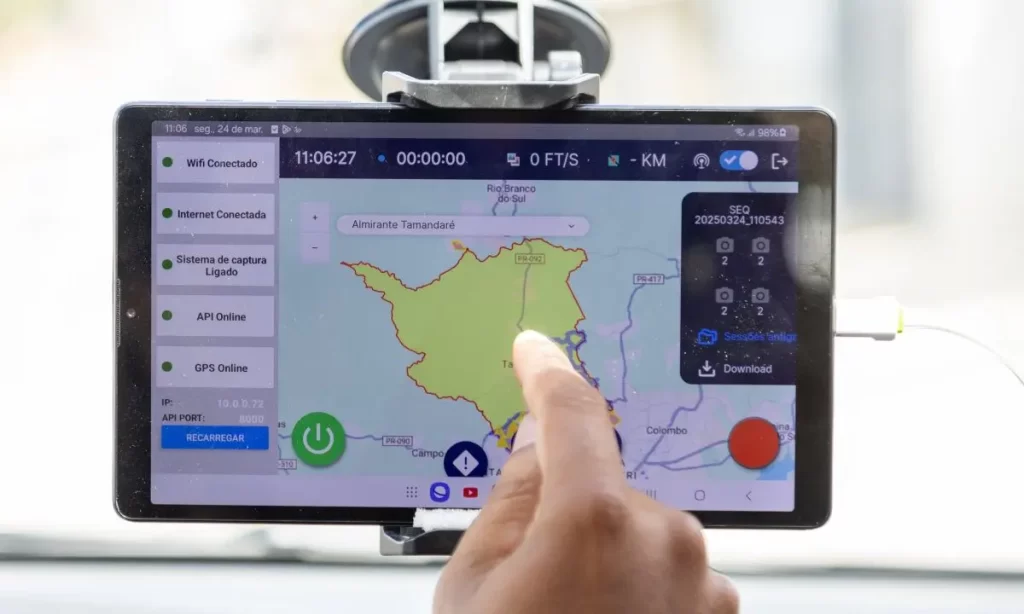
In line with the model used to read data from cylinders, the company also began using cameras to count the number of cylinders as the truck passes. This reduces the average time spent manually counting from seven minutes to 30 to 40 seconds using an AI object identification algorithm.
Furthermore, it is using the cylinder camera system to identify flaws in the cylinder’s paintwork and another artificial intelligence algorithm to determine the availability of cylinders at the base. In this last step, the company
It knows the container needs at each of its bases and can even calculate demand.
Telemetry is also on the IT agenda. Since it began using it to read driver behavior and generate alerts, the number of incidents has decreased by 91%, says Baltensberger.